Deck Railings in Muskoka: Glass, Aluminum, Cable and Wood Systems
Ontario Building Code compliant railing systems that protect your family without blocking your lake views.
Get a Free QuoteWhat Are the Railing Options for Muskoka Decks?
Deck railings serve two purposes: safety and aesthetics. The Ontario Building Code sets minimum requirements for guard height, baluster spacing and load resistance. Within those requirements, property owners can choose from several railing systems that range from traditional wood to frameless glass. On lakefront properties, the choice of railing has a significant impact on sightlines and how the deck connects visually to the water.
Railing Types Compared
| Railing Type | Cost (per linear ft) | View Impact | Maintenance | Best For |
|---|---|---|---|---|
| Glass Panels | $80 - $150 | Minimal | Seasonal cleaning | Lakefront view preservation |
| Cable | $50 - $100 | Low | Occasional tensioning | Modern look, open views |
| Aluminum | $40 - $80 | Moderate | None | Low-maintenance durability |
| Wood | $30 - $60 | Moderate to high | Stain every 1-3 yrs | Traditional cottage look |
* Costs are estimates based on typical Muskoka projects.
Ontario Building Code Requirements for Deck Railings
Every deck railing in Ontario must meet the guard requirements in the Ontario Building Code (OBC). The key requirements are:
Minimum guard height: 36 inches (900 mm) for decks under 5 feet 11 inches above grade; 42 inches (1,070 mm) for higher decks.
Baluster spacing: No opening in the guard that allows a 4-inch (100 mm) sphere to pass through.
Load resistance: The guard must withstand a concentrated load of 0.5 kN applied at any point on the top rail and 1.0 kN/m distributed along the top rail.
Climbability: Horizontal elements (like cable railings) must be evaluated for climbability. Cables spaced less than 4 inches apart are generally acceptable.
Glass Railings for Lakefront Decks
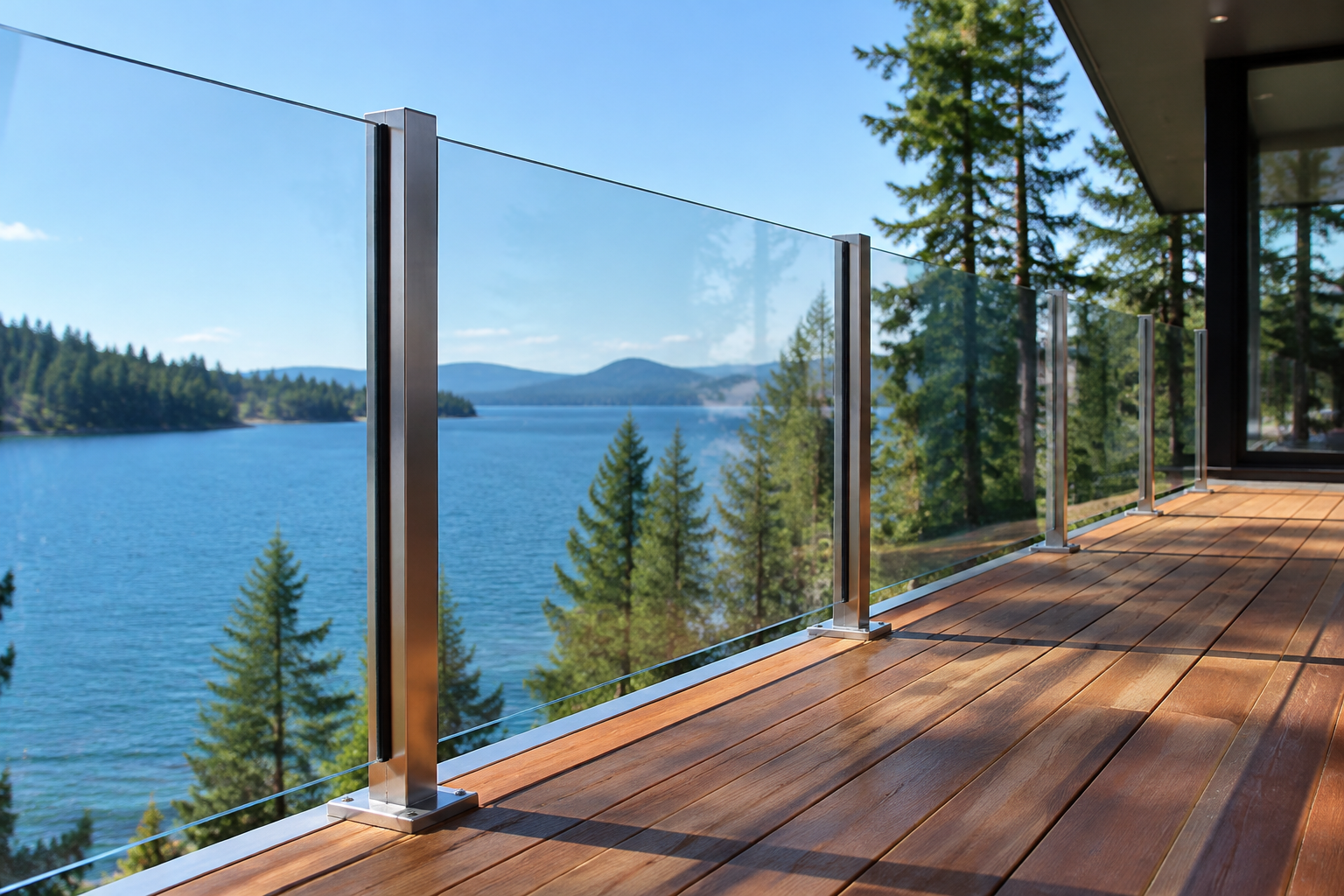
Glass panel railings are the most popular choice for lakefront decks in Muskoka because they provide safety without blocking the view. The panels are made from tempered safety glass (typically 10 mm or 12 mm thick) mounted in aluminum base channels or point-fixed with stainless steel clamps. Top-mounted and side-mounted configurations are both available.
Frameless (or semi-frameless) glass railings have no top rail, creating the most open visual experience. Framed glass railings use an aluminum top rail that adds rigidity and can double as a drink rail.
Cable Railings
Horizontal cable railings use stainless steel cables (typically 1/8-inch or 3/16-inch diameter) strung between metal or wood posts. The cables are nearly invisible from a distance, providing open views at a lower cost than glass. Cable railings need periodic tensioning as the cables stretch over time, but otherwise require minimal maintenance.
Aluminum and Wood Railings
Aluminum railings are the most durable low-maintenance option. They do not rust, rot or need painting, and they come in a range of colours to match the deck and cottage exterior. Wood railings (pressure-treated or cedar) offer a traditional cottage look but require regular staining and are more susceptible to weathering in the Muskoka climate.
Deck Railing Questions
Get a Free Deck Railing Quote
Tell us about your railing project and preferred style, and we will prepare an estimate.